
There is a question that surfaces, sooner or later, in almost every serious conversation about education: what, exactly, are we preparing children for? The answer shapes everything, what we teach, how we teach it, and what kind of people we hope to send into the world.
Somewhere along the way, modern education absorbed a peculiar idea: that the mind and the soul are separate territories, best managed by separate departments. That a child’s intellectual development is one matter, and their character, values, and sense of meaning are entirely another. At VICA, we have never believed this. And the longer we teach, the more convinced we become that this separation is not just philosophically mistaken, it is quietly harmful.
Begin with a simple observation. Think of a brilliant person you know, genuinely gifted, academically accomplished, who has nevertheless caused tremendous harm. To a colleague. A family. A community. Perhaps even to themselves. The intelligence was real. The capability was real. But something was missing. Something that no examination paper had ever thought to measure.
Now think of someone whose formal qualifications were modest, but whose character was exceptional, a person of unusual integrity, deep compassion, and a settled sense of purpose. That person, you will notice, tends to leave places better than they found them. Their presence is stabilising. Their influence endures. They are, in the truest sense, an educated person.
This is not to romanticise ignorance or to dismiss the rigour of academic discipline. Excellence in mathematics, literacy, science, and critical thinking matters enormously. It is a gift we are duty-bound to cultivate in every child we teach. But the question is not whether to pursue academic excellence. The question is: excellence in service of what?
A child can be taught to solve equations and still not know why their life matters. They can be trained to pass examinations and still have no compass by which to navigate the harder questions , questions about what is right, what is true, and what is worth living for.
VICA Leadership Perspectives
The False Peace of Keeping Things Separate
The modern habit of separating academic and spiritual formation feels, on the surface, like wisdom. Keep religion out of the classroom, keep emotion out of the curriculum, keep faith private. What we end up with, we are told, is a clean, neutral space, a kind of intellectual Switzerland where all views are equally welcome and none is privileged.
But this neutrality is a fiction. Every curriculum carries assumptions. Every classroom operates according to values, about what knowledge is worth having, about how human beings ought to treat one another, about what success means. The question is never whether values will shape education. The question is which values, and whether anyone will be honest enough to name them.
When a school teaches children to compete relentlessly with one another and measures their worth entirely by their rank, it is teaching values, just not the ones it would admit to. When a school teaches that self-advancement is the primary purpose of learning, it is forming character, just not a very admirable one. Spiritual formation, in this sense, is unavoidable. Every school is already in the business of shaping souls. The only choice is whether to do it intentionally, or by accident.
01 – Knowledge Without Virtue
A student who graduates with top marks but no moral compass is not an educational success. They are a liability to themselves and to every institution they will one day lead.
02- Virtue Without Capability
Good intentions without competence are not enough either. Compassion must be matched with the skill to act effectively. Character and excellence are both non-negotiable.
03 – The Integration We Need
What the world genuinely needs, what Uganda genuinely needs is people in whom intellectual rigour and moral seriousness have been formed together, from the very beginning.
04 – The ACE Difference
Our curriculum is not biblical content bolted onto academic subjects. Faith and learning are woven together at the root, because they spring from the same source: the character of God.
What God-Centred Education Actually Means
We use the phrase “God-centred education” at VICA, and it would be easy to hear this as a slogan, a piece of branding that sounds noble but has little to do with what actually happens in our classrooms on a Tuesday morning. So let us be specific about what we mean.
We mean that when a child in our school is learning mathematics, they are also learning something about the deep orderliness of creation, about the fact that reality is not random, that it has structure, and that this structure is intelligible to the human mind. This is not a small thing. It is, in fact, a profound invitation to wonder.
We mean that when a child is learning to write, they are also learning that language is sacred, that words have weight, that clarity is a form of respect for others, and that the ability to communicate well is a gift to be used in service of truth, not merely in service of the self.
We mean that when a child is learning about the natural world in our science laboratory, they are learning to be curious in a way that is ultimately reverent, that the universe is not merely data to be processed, but a creation to be honoured.
None of this requires removing rigour. It requires adding depth. The academic and the spiritual are not two separate rooms in a house; they are the same room, furnished with care.
“The fear of the Lord is the beginning of wisdom, and knowledge of the Holy One is understanding.”
Proverbs 9:10
The Problem with Raising High-Achievers
There is a particular kind of anxiety that has taken hold of parents and educators in recent decades, an anxiety centred on the idea that what children most need is to be high-achievers. To score well, to rank highly, to secure the scholarship, to win the place at the prestigious institution. This anxiety is not irrational. The world is competitive. Doors do open and close on the basis of credentials.
But it is worth asking an uncomfortable question: high-achieving in what, and for what? History is generously supplied with high-achievers who used their gifts to accumulate power, to exploit others, or simply to live in spectacular, comfortable mediocrity, technically accomplished but personally hollow.
The goal we have set ourselves at VICA is more demanding than this. We want to graduate students who are excellent, but excellent in the way that a tree is excellent when it is both tall and deeply rooted. The rootedness is not a limitation on the height. It is the very condition that makes it possible.
A child formed in the knowledge that they are made by God, known by God, and called to a purpose beyond their own comfort will approach their education differently from one who has been told, implicitly, that their worth is their grade point average. They will approach failure differently. They will approach success differently. They will treat the child in the next chair differently.
Character Is Not an Extra-Curricular
One of the subtlest errors in contemporary schooling is to treat character formation as something that happens alongside the curriculum, in assemblies, in chapel, in pastoral time, in the occasional Values Week. All of these things have their place. But if character formation is only happening in the margins, then the message the curriculum sends, by implication, is that character is marginal.
At VICA, we take a different position. Character is not what we add to the curriculum. Character is what the curriculum is for. Every time a student persists with a difficult PACE booklet when they want to give up, they are learning perseverance. Every time they are honest about a wrong answer instead of pretending otherwise, they are practising integrity. Every time they cheer for a classmate’s achievement instead of resenting it, they are growing in generosity.
These are not separate from academic learning. They are the conditions under which genuine academic learning becomes possible. A child who lacks the perseverance to sit with difficulty will never go deep in mathematics. A child who lacks the honesty to acknowledge what they do not know will never become a true scientist. A child who sees every peer as a rival to be defeated will never become the kind of person who builds something worth building.
Excellence and virtue are not merely compatible. They are mutually constitutive. Each makes the other more possible.
We are not in the business of producing people who are impressive to look at from a distance. We are in the business of producing people who are genuinely good and genuinely capable up close.
Our Philosophy of Education
What We Owe the Children in Our Care
Every child who walks through the gates of Vine International Christian Academy arrives carrying something most schools never directly address: a question about their own significance. Am I loved? Do I matter? Is there a reason I am here? These are not questions that disappear when lessons begin. They are the questions that determine whether anything in a lesson is actually heard.
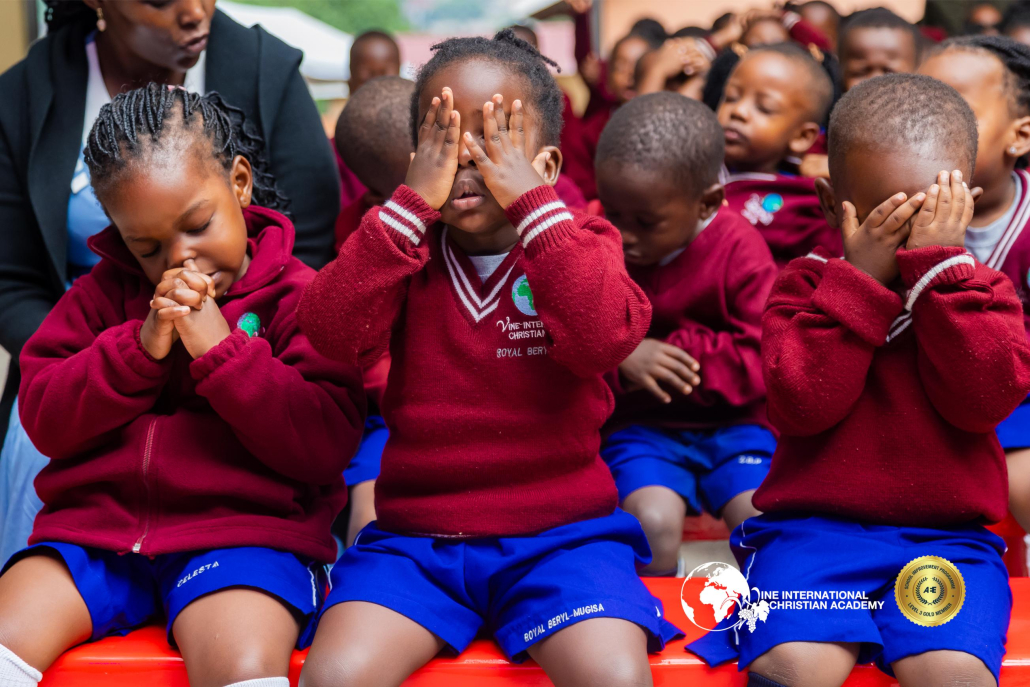
A school that can only answer the question “what should you know?” but cannot speak to the question “who are you, and why does your life matter?” is leaving its students with a large and consequential gap in their formation. They will find answers to those questions somewhere. The only question is whether we will have been honest and courageous enough to help them find good ones.
At VICA, our answer to the question of human significance is not vague or diplomatic. We believe each child is made in the image of God, known and loved before they took their first examination or ran their first race. We believe this not as a pastoral add-on, but as the foundation of everything else we do. From this foundation, excellence becomes not a means of securing significance, but an expression of gratitude for it.
This is why we refuse to separate academic excellence from spiritual formation. Not because we are uninterested in academic standards, we are deeply interested; we hold ourselves and our students to the highest we can imagine, but because we believe that separated from their roots, those standards become hollow. And a hollow education, however decorated with certificates, is an education that has missed the point.